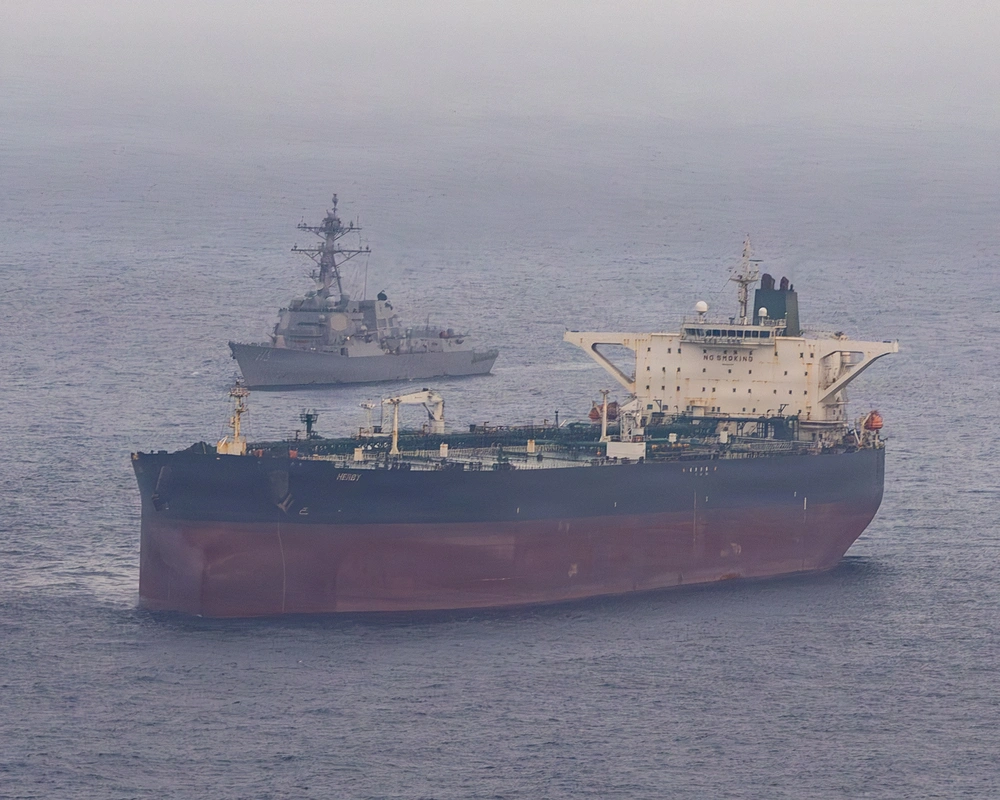
USS Rafael Peralta enforces the maritime blockade, April 24, 2026. Photo: U.S. Navy / NAVCENT Public Affairs.
Late Monday, Reuters reported that the United States had struck Iran’s Qeshm Island, citing The Wall Street Journal and American officials. Iranian media reported explosions, while U.S. Central Command had not publicly confirmed that specific location. A U.S. official later told the Associated Press that American forces had conducted limited defensive strikes against Iranian targets in the Strait of Hormuz after surface-to-air missiles were used against U.S. assets. The strikes were described as limited and deliberately quiet, even as President Donald Trump publicly answered “No” when asked whether he was considering another attack after the midterm elections.
Diplomats are also trying to stop an eight-month conflict that has disrupted shipping and energy markets. Even when the fighting is overseas, families here can still feel it through gasoline prices, the cost of food, delayed shipments, or the failure of systems they depend upon.
A War That Reaches Beyond the Battlefield
Iran and the United States remain divided over Tehran’s nuclear program, the American blockade of Iranian ports, sanctions, oil sales, and the reopening of the Strait of Hormuz. After talks in Doha ended without a breakthrough, Iranian Foreign Minister Abbas Araqchi said, “Consultations through mediators are very intensive”. Iran’s proposal would link reopening Hormuz to an end of the blockade, relief for oil sales, and the cancellation of new sanctions. Washington continues to demand verifiable guarantees that Iran will not rebuild its nuclear program.
This matters far beyond Iran. Hormuz is a major route for oil and liquefied natural gas. When tankers are delayed, attacked, or forced away from normal routes, transportation and insurance costs rise. Those expenses can appear in fuel bills, food prices, airline tickets, and manufacturing costs. Civilians bear the heaviest burden as families face fear, displacement, and broken services while governments argue over military and economic pressure.
When Essential Systems Become Targets
In July, CISA, the FBI, the Environmental Protection Agency, and other federal partners warned that Iranian-affiliated actors were targeting internet-connected controllers used in American water, wastewater, energy, and government facilities. The agencies said the activity had produced operational disruption and financial loss. An FBI official warned that Iranian actors continue to target critical infrastructure and could disrupt “the essential services Americans rely on.”
Iranian security officials have also threatened undersea communications cables, data centers, and other digital infrastructure if major attacks resume. A threat is not the same as a completed operation, but it identifies the kind of systems military planners now consider part of the battlefield.
Europe received a practical warning on November 2. Hackers altered refrigeration temperatures at more than 100 stores across several countries, forcing businesses to discard food. “Everything is destroyed,” one Swedish store manager told Reuters. Investigators had not connected those incidents to Iran. However, they showed how an exposed digital controller can lead to spoiled food, closed stores, and immediate financial loss. How prepared are we when the technology supporting ordinary life suddenly stops working?
What Will We Accept in Exchange for Security?
National emergencies often produce demands for speed, access, and expanded authority. Congress passed the USA PATRIOT Act shortly after September 11, 2001, broadening investigative and surveillance powers to prevent terrorism. That history gives Americans a reason to examine every new emergency measure carefully. What information will be collected? Who may access it? What court or legislature will provide oversight? When will temporary authority end?
We also need to be careful and accurate when talking about digital money. A January 2025 executive order prohibited federal agencies from establishing or promoting a U.S. central bank digital currency. A separate order moved federal payments and receipts toward electronic methods while preserving exceptions. The GENIUS Act created a legal framework for privately issued payment stablecoins, and new OCC regulations take effect January 18, 2027. As money becomes more programmable and dependent on private and government-controlled networks, citizens should ask how privacy, due process, access, and religious conscience will be protected.
Revelation 13:17 warns of a power that causes “that no man might buy or sell” apart from submission to its authority. The prophecy concerns worship, allegiance, coercion, and conscience. Christians should understand the systems being built and defend the freedom of every person before a crisis becomes the excuse for controlling conviction.
Preparation That Reaches the Heart
Prudence is not panic. Proverbs 22:3 says, “A prudent man foreseeth the evil, and hideth himself.” A household can calmly maintain several days of drinking water, shelf-stable food, necessary medication, lighting, a radio, charged batteries, and dependable ways to receive information. Preparation should also make us more able to assist an elderly neighbor, a struggling family, or someone displaced by disaster.
The deeper preparation concerns character. Jesus said, “And ye shall hear of wars and rumours of wars: see that ye be not troubled” (Matthew 24:6). He did not tell His people to ignore danger. He commanded them not to be ruled by fear.
Ellen White wrote, “It is in a crisis that character is revealed” (Christ’s Object Lessons, p. 412). So what would a crisis reveal about us? Do we seek God only when we are afraid, or are we learning to trust Him now? If food becomes scarce, will we think only about protecting ourselves, or will we still see the needs of others? If obeying God one day costs us comfort, employment, or the ability to participate in society, will we have the faith to stand?
Those questions must be answered before the crisis arrives. We should prepare our homes, but above all, we must prepare our hearts. Watch what is happening. Help those who are suffering. Defend the conscience of every person. Pray, study God’s Word, and like Paul, let us have the confidence to say, “For I am persuaded, that neither death, nor life, nor angels, nor principalities, nor powers, nor things present, nor things to come, Nor height, nor depth, nor any other creature, shall be able to separate us from the love of God, which is in Christ Jesus our Lord” (Romans 8:38, 39).
Sources
- Reuters: Reported U.S. strike on Qeshm Island
- Associated Press: U.S. official confirms limited defensive strikes
- Reuters: U.S.–Iran negotiations and Hormuz proposal
- CISA: Iranian-affiliated targeting of industrial controllers
- Reuters: European supermarket refrigeration attacks
- Reuters: Iranian threats against Gulf communications cables
- GovInfo: USA PATRIOT Act of 2001
- White House: Order prohibiting a federal CBDC
- White House: Electronic federal-payments order
- OCC: Final GENIUS Act regulations
- FEMA: Emergency supply-kit checklist
Leave a Reply
You must be logged in to post a comment.