SWISS CHURCHES, UNIONS, AND POLITICAL PARTIES JOIN FORCES TO DEFEND SUNDAY
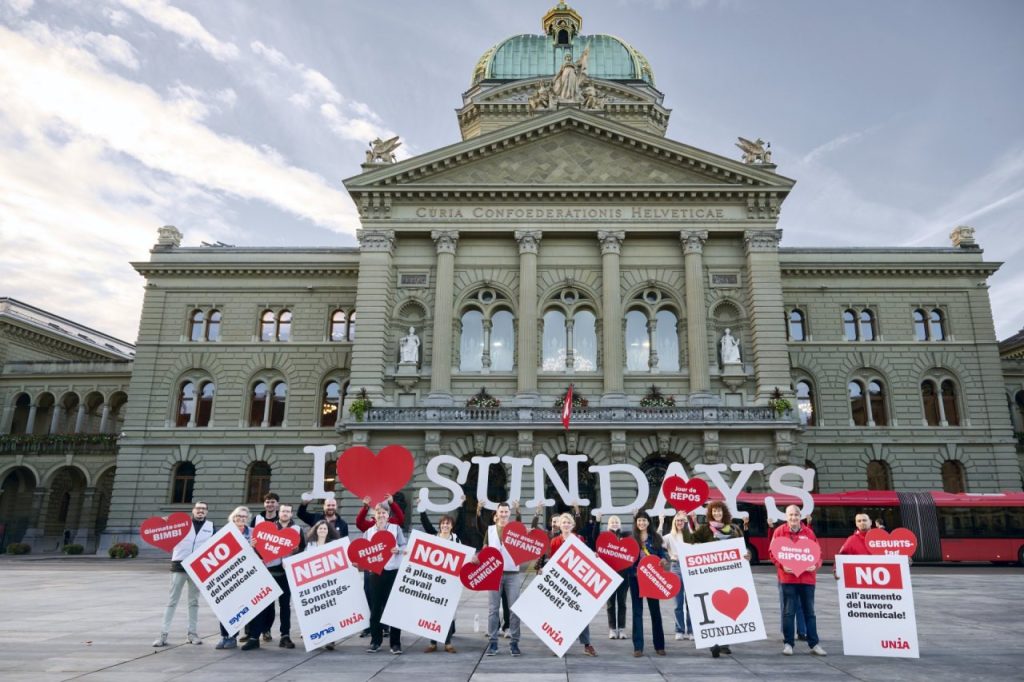
Unia campaigners gathered on October 2, 2026, to give lawmakers flyers opposing expanded Sunday work. Photo: Manu Friederich.
On October 2, 2026, Switzerland’s National Council voted 97 to 95, with four abstentions, to keep alive a proposal that could allow retail employees to work on as many as twelve Sundays a year without a special permit. The current limit is four. The vote did not change the law, but it reopened a proposal that the other chamber of Parliament had rejected in June. Swiss Parliament
The narrow vote reveals a country divided over Sunday shopping. The response to the proposal reveals something else: churches, labor unions, women’s organizations, and political parties have come together to defend Sunday as a common day of rest.
HOW THE PROPOSAL RETURNED
The proposal originated with the canton of Zurich. Its supporters want cantons to have the option of allowing more permit-free Sunday sales, arguing that physical stores need greater flexibility to compete with online shopping and retailers across the border.
On June 9, the Council of States voted 22 to 21, with one abstention, against taking up the proposed change. Members of the Social Democrats, Greens, Centre, and Swiss People’s Party joined in opposing it. Swiss People’s Party member Jakob Stark told the chamber, “The value of Sunday must be preserved.”
The National Council’s October vote kept the Zurich proposal in Parliament. For now, the existing Sunday rules remain in place. The two chambers have not agreed to expand the limit to twelve.
On October 13, a Council of States committee voted 6 to 2, with three abstentions, to stand by its proposal for up to twelve permit-free retail Sundays. Parliament says the full Council of States will return to the matter during its winter 2026 session.
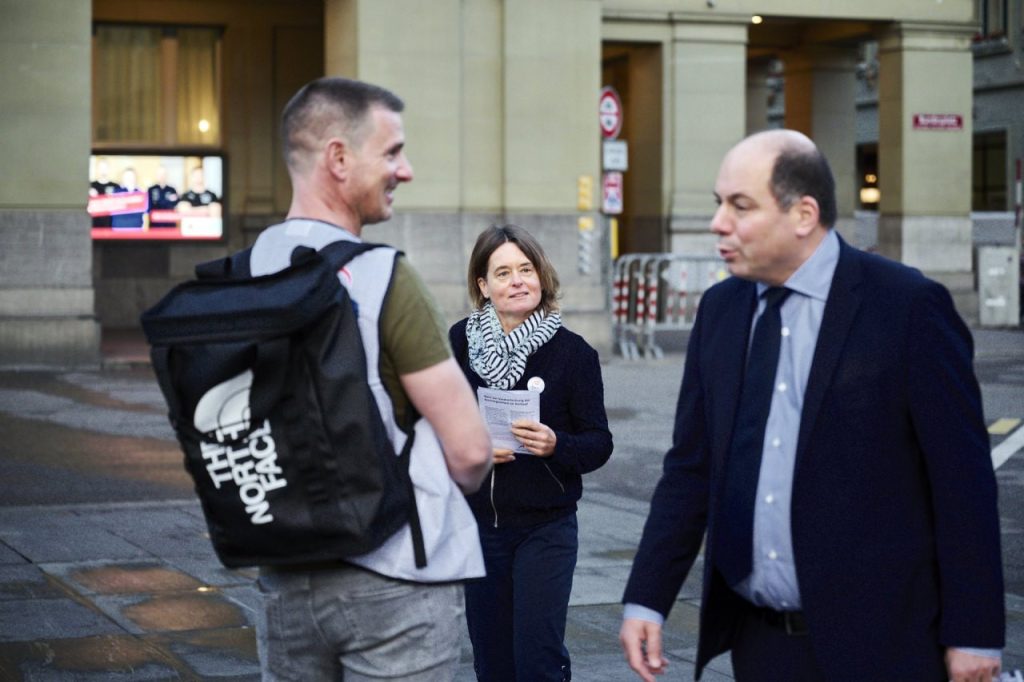
Retail worker Doris Schneeberger speaks with National Council member Mauro Tuena outside Parliament before the Sunday-work vote. Photo: Manu Friederich.
AN ALLIANCE THAT CROSSES FAMILIAR LINES
Before the October vote, the Swiss Sunday Alliance urged lawmakers to reject the proposal. Its statement was backed by the Swiss Bishops’ Conference, the Swiss Reformed Church, an association of free churches, the Social Democratic Party, Christian political parties, labor unions including Unia and Syna, and women’s organizations. The alliance also identifies occupational medicine among the fields represented in its coalition.
Think about that for a moment. These organizations do not approach every question from the same political, social, or religious position. Yet they are asking the government to preserve Sunday’s protected place in the working week.
The alliance’s position is direct: “Exceptions should remain exceptions.” It describes Sunday as a shared day for family, community, recreation, and religious practice. It also argues that expanding Sunday work would weaken workers’ recovery time and social cohesion.
Adrian Wüthrich, president of Travail.Suisse, explained the personal side of that argument: “For many employees, Sunday is the common day off they can spend with their family and friends.” His organization says it will seek a referendum if the proposal ultimately becomes law.
WHY ADVENTISTS SHOULD PAY ATTENTION
Workers need rest, and families need time together. We can recognize those needs while still asking why Sunday, specifically, is the day that such a broad coalition wants the state to protect.
That is the part of this story Adventists should not overlook. Sunday is being defended through arguments that reach beyond church attendance. It is presented as a benefit to workers, families, health, and society as a whole. Religious practice is included within that public case for a common day.
Scripture directs us to a different day as God’s Sabbath: “But the seventh day is the sabbath of the LORD thy God.”Exodus 20:10.
When the king of Babylon commanded worship, the three Hebrews answered: “But if not, be it known unto thee, O king, that we will not serve thy gods, nor worship the golden image which thou hast set up.” Daniel 3:18. Their answer shows where the authority of civil power ends. Worship and obedience to God cannot be settled by a government decree or by the number of people who support it.
The question for us is how to speak clearly when a popular social cause and a religious tradition meet in civil law. Ellen G. White counseled believers to “bring before them the real question at issue” when liberty of conscience is at stake. Testimonies for the Church, vol. 5, p. 452.
She also warned that “We are not doing the will of God if we sit in quietude”, urging believers to act to preserve liberty of conscience. Testimonies for the Church, vol. 5, p. 713. That counsel calls us to understand what is happening, speak clearly about the Sabbath, and defend the freedom of every conscience.
Switzerland is debating how many Sundays retailers may open without a permit. But the close votes have also brought something else into view: churches, unions, and people from different political backgrounds are standing together to preserve Sunday as a common day of rest. They may disagree on other issues, but here they have found common cause.
That is why Adventists should watch what Parliament does when it returns to the proposal this winter. We should listen to the arguments being made, speak clearly for the seventh-day Sabbath, and defend liberty of conscience for everyone. The vote was close, and the coalition defending Sunday is broad. Both deserve our attention.
SOURCES
Swiss Parliament, National Council decision, October 2, 2026
Swiss Parliament, Council of States debate and decision, June 9, 2026
Swiss Parliament, Council of States committee decision, October 13, 2026
Swiss Sunday Alliance, statement to the National Council, October 2, 2026
Travail.Suisse, response to the National Council vote, October 2, 2026
Ellen G. White, Testimonies for the Church, vol. 5, pp. 452, 713
Leave a Reply
You must be logged in to post a comment.