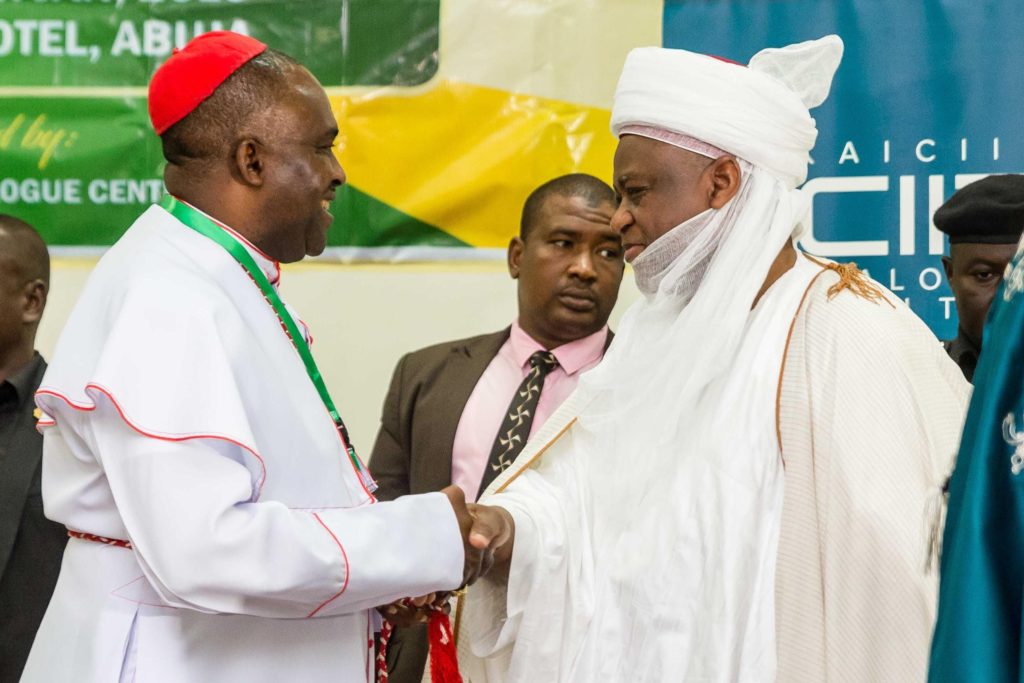
 CHRISTIAN AND MUSLIM LEADERS SIGN INTERFAITH ACCORD AS RELIGION AND GOVERNMENT UNITE FOR PEACE
More than 50 Christian and Muslim leaders have signed an interfaith peace accord in Abuja, Nigeria, establishing an organization designed to coordinate religious and civic action throughout West Africa.
Organized by the Muslim World League, the conference was held under the patronage of Nigerian President Bola Ahmed Tinubu. Religious leaders, government ministers, parliamentarians, state governors, and civil-society representatives participated.
According to the Muslim World League, the “Abuja Declaration” established a:
The stated objectives—preventing violence, opposing extremism, and protecting human life—are worthy. However, this event is significant because religion, government, education, media, and civil society are being organized around a shared social agenda.
RELIGIOUS LEADERS READY TO “TURN A NEW PAGE”
Muslim World League Secretary-General Mohammed Al-Issa said the two faiths were prepared to “turn a new page.”
Christian leader John Praise Daniel called for an end to religious hostility:
“No hate speech, and no disrespect for other religious groups, no calling of people as infidels.”
Khalid Abubakar of Jama’atu Nasril Islam explained:
“It is not a call to leave your own religion, but a cooperation of working together in harmony.”
The participants are not creating one new religion. Instead, they are cooperating while retaining their separate religious identities.
That distinction is important. A religious coalition does not require complete doctrinal agreement. Different faiths can remain separate while working together toward common political and social objectives.
MORE THAN A SYMBOLIC MEETING
The conference produced formal agreements between Christian and Islamic organizations. It also established a permanent Coordinating Body for Religious and Civic Leaders and Institutions in West Africa.
According to the official announcement, this body will oversee the agreements and ensure:
The Abuja Declaration also calls for academic, training, and media programs promoting religious coexistence and social stability. This is therefore an organized structure involving religious authority, government participation, education, and public communication.
WHAT IS GOOD—AND WHAT REQUIRES CAUTION
Nigeria has suffered years of terrorism and religious violence. Christians and Muslims have been killed, families displaced, and communities devastated.
Christians should welcome sincere efforts to prevent bloodshed.
Jesus said:
“Blessed are the peacemakers: for they shall be called the children of God.”
Matthew 5:9
Paul wrote:
“If it be possible, as much as lieth in you, live peaceably with all men.”
Romans 12:18
Christians should love their Muslim neighbors, defend their religious liberty, and protect them from violence. But peaceful coexistence must not be confused with spiritual unity.
Christianity and Islam proclaim different messages about Jesus Christ. The Bible declares:
“In the beginning was the Word, and the Word was with God, and the Word was God.”
John 1:1
Jesus said:
“I am the way, the truth, and the life: no man cometh unto the Father, but by me.”
John 14:6
Christians cannot conceal these truths to preserve an interfaith partnership. Ellen White wrote:
“The peace of Christ is born of truth. It is harmony with God.”
—Ellen G. White, Our High Calling, p. 266.
We can treat everyone with love and work to prevent violence without teaching that every religion leads to God.
WHEN RELIGION AND GOVERNMENT WORK TOGETHER
Nigeria’s Deputy Senate President Barau Jibrin represented President Tinubu at the conference. Speaking about the government’s position, he said:
National unity is a legitimate concern. But government should protect religion without becoming united with religious authority.
Whenever religious leaders, government institutions, education, and media operate through a common organization, important questions must be asked:
Who will define extremism? Could proclaiming Christ as the only Savior be considered disrespectful? Will minority believers remain free when their convictions conflict with the coalition’s objectives?
These questions do not accuse every participant of planning persecution. They recognize the danger that arises when religious influence and civil authority become structurally connected.
Ellen White wrote:
“God never forces the will or the conscience.”
—Ellen G. White, Mind, Character, and Personality, vol. 2, p. 640.
No government or religious coalition should attempt to do what God Himself refuses to do.
THE PROPHETIC SIGNIFICANCE
The Abuja Declaration is not the fulfillment of Revelation 13. It does not enforce Sunday observance, prohibit Sabbathkeeping, or compel worship.
Nevertheless, it shows how different religions, governments, and civic institutions can cooperate around common objectives without becoming one denomination.
Revelation describes earthly powers working together:
“These have one mind, and shall give their power and strength unto the beast.”
Revelation 17:13
Revelation 13 then describes civil authority enforcing religious allegiance and applying economic pressure:
“And that no man might buy or sell, save he that had the mark.”
Revelation 13:17
The final prophetic coalition will not require every participating power to believe the same doctrines. They only need to cooperate in support of a common religious objective.
Ellen White warned:
“The professed Protestant world will form a confederacy with the man of sin, and the church and the world will be in corrupt harmony.”
—Ellen G. White, The Seventh-day Adventist Bible Commentary, vol. 7, p. 975.
The Nigerian agreement is not that final confederacy. But it demonstrates how religious institutions, civil governments, and social organizations can establish a shared program while retaining their separate identities.
A TIME TO WATCH AND PREPARE
This development should not produce panic or exaggerated claims. It should cause God’s people to watch.
More than 50 Christian and Muslim leaders have signed formal agreements. Government officials, religious organizations, education, media, and civil society have been included in a common action plan. A permanent body has been created to supervise its implementation.
We should support efforts to prevent violence while refusing to compromise biblical truth. We should defend religious liberty for everyone while carefully watching the relationship between religion and civil power.
Now is the time to study, defend liberty of conscience, proclaim the Three Angels’ Messages, and develop a faith that will remain loyal to God when conformity is demanded.
“Therefore let us not sleep, as do others; but let us watch and be sober.”
1 Thessalonians 5:6
“Here is the patience of the saints: here are they that keep the commandments of God, and the faith of Jesus.”
Revelation 14:12
SOURCES
[1] Reuters, “Nigeria Faith Leaders Sign Peace Accord Months After Trump Remarks,” August 13, 2026.
Leave a Reply
You must be logged in to post a comment.