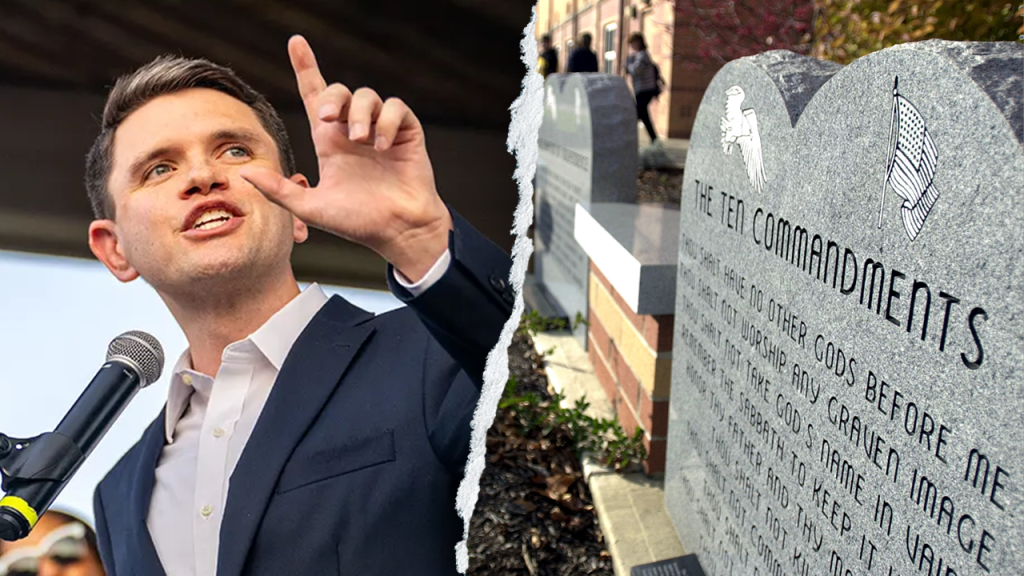
Talarico beside a Ten Commandments monument by Fox News
On November 3, 2026, Democrats won control of both chambers of Congress. The Associated Press called the Senate at 11:36 p.m. and the House early Wednesday morning. Among the most surprising victories were James Talarico in Texas and Adam Hamilton in Kansas, two candidates who openly connected their campaigns to their Christian faith.[1]
The new Congress will convene in January, raising an important question: What happens to the religious-liberty issues we have been watching when political power changes hands?
A Democratic victory is not evidence that the party is preparing Sunday legislation. However, religious language, appeals to Christian values, interfaith cooperation, and government involvement with religion are appearing across the political spectrum.
The Religious Left Returns
Talarico is a Presbyterian seminarian, while Hamilton pastors a large United Methodist congregation. Both presented Christianity as a call to love their neighbors, defend the vulnerable, and seek justice.
Talarico’s campaign promised a democracy where every person, “regardless of religion, race, gender, sexual orientation, or any other difference between us,” could be free.[2] He supports the separation of church and state and opposes government policies that elevate Christianity over other religions.
Hamilton said his faith compelled him to enter politics because what was happening in Washington “didn’t reflect our national values.”[3] Other victorious Democrats included Christian clergy, Jewish candidates, and Abdul El-Sayed, who became the first Muslim elected to the United States Senate.
The political right is no longer the only side invoking faith. Christian language is now being used to promote different political visions on both sides.
Which Day Is the Sabbath?
Talarico previously attracted national attention during the Texas debate over requiring the Ten Commandments in every public-school classroom.
The debate occurred on Saturday, with a final vote scheduled for Sunday. Representative Candy Noble, the bill’s sponsor, identified Saturday as the Jewish Sabbath and Sunday as the Christian Sabbath.
Talarico asked, “Would you be willing to postpone your bill so that we’re not breaking the Ten Commandments by working on the Jewish or Christian Sabbath?”[4]
But what does the commandment itself say?
“But the seventh day is the sabbath of the LORD thy God.” Exodus 20:10, KJV.
How can this be merely the Jewish Sabbath if the seventh day is the LORD’s Sabbath?
Texas enacted the classroom-display law in 2025. In April 2026, the Fifth Circuit reversed an injunction and dismissed the families’ constitutional claims. The families petitioned the United States Supreme Court, but as of November 6, the Court had not agreed to hear the case. A response remained due November 10.[5]
Sunday Rest From the Right and the Left
While Democrats speak about Christian values and religious pluralism, conservative organizations continue discussing Sunday-centered public policy.
Project 2025’s Labor chapter proposed requiring time-and-a-half pay for covered employees working on the Sabbath. The designated day “would default to Sunday,” with exceptions for employers sincerely observing another Sabbath and certain essential operations.[6] The author, Jonathan Berry, now serves as Solicitor of Labor. The proposal was accompanied by an opposing conservative view and has not become federal law. Current federal law does not require premium pay simply because someone works on Saturday or Sunday.[7]
In January 2026, the Heritage Foundation separately encouraged communities to consider a “uniform day of rest”limiting commercial activity. It connected common rest with religious observance, family gatherings, outdoor activity, mental health, and social cohesion.[8]
The North American Division of Seventh-day Adventists warned that such restrictions create practical burdens for Adventists and Orthodox Jews and represent a “dangerous desire to use state power to advance religious objectives.”[9]
Similar arguments have appeared elsewhere. Spain’s left-wing SUMAR group proposed limiting Sunday and holiday openings to protect family life and Sunday rest, but the proposal expired on October 6 without becoming law.[10] In Montenegro, 62 government and opposition lawmakers voted to restore Sunday closing restrictions after the Constitutional Court struck down the earlier provision.[11]
Christian Values, All Religions, and Fiji
In Fiji, the Methodist Church submitted a proposal calling for the country to be recognized as a Christian nation and for Sunday to become a constitutionally protected day of worship and rest, with essential services excepted.[12]
That exact Sunday proposal is absent from Fiji’s current Constitution Amendment Bill. Yet the bill declares that Fiji is founded on “Christianity and family values” and says worship and reverence for God are the source of good governance and leadership. The same bill states that government must treat every religion equally and must not advance one religion over another.[13]
During public consultations, Methodist Church President Reverend Dr. Semisi Turagavou also proposed a national prayer day involving Christians, Muslims, Hindus, and other religious groups.[14] The constitutional bill remains under committee review, with its third-reading vote expected in December.
Here we see appeals to Christian identity, family values, national unity, Sunday rest, and participation by different religions appearing within the same national discussion.
Respecting Muslims, Hindus, Jews, and people of every faith does not require Christians to claim that all religions teach the same truth about God. We can defend every person’s freedom of conscience while remaining faithful to Jesus Christ and the Bible.
What Should Adventists Do?
Seventh-day Adventists must refuse to place their hope in either political party. We should watch developments carefully, study Scripture, pray, defend liberty of conscience for everyone, and faithfully share the Sabbath truth.
“Walk in wisdom toward them that are without, redeeming the time.” Colossians 4:5, KJV.
Revelation 13 and 14 warn, according to the Adventist prophetic understanding, that worship, civil authority, and obedience to God will eventually become the center of a worldwide conflict. That does not permit careless accusations. It calls for spiritual discernment and action grounded in verified facts.
Ellen White wrote: “Let there be most earnest prayer, and then let us work in harmony with our prayers.”[15]
Governments change. Political coalitions rise and fall. Religious language can come from the right, the left, churches, unions, or interfaith movements. Our responsibility remains the same: uphold God’s law, defend freedom of conscience, reveal the character of Christ, and help the world understand that the seventh day is the Sabbath of the Lord.
Sources
- Associated Press: Calling Control of Congress in the 2026 Midterms
- James Talarico: Freedom, Family & Faith
- Associated Press: Clergy Candidates’ “Love Your Neighbor” Message
- PBS: Full Conversation with James Talarico
- U.S. Supreme Court Docket 26-257
- Project 2025: Mandate for Leadership, Labor Chapter
- U.S. Department of Labor: Overtime Pay
- Heritage Foundation: Saving America by Saving the Family
- North American Division: Sunday Rest Proposal Raises Religious-Liberty Concerns
- Spanish Congress: Proposed Bill 122/000277; Legislative Status: Concluded and Expired October 6, 2026
- Vijesti: Government and Opposition Restore Montenegro’s Sunday Restrictions
- Fiji Village: Methodist Church Constitutional Submission
- Parliament of Fiji: Constitution Amendment Bill 2026
- Fiji Village: National Day of Prayer for People of All Faiths
- Ellen G. White, Testimonies for the Church, Volume 5, p. 713
Leave a Reply
You must be logged in to post a comment.